
Getting Traffic But No Sales? How to Fix a Clothing Brand Shopify Store
If people visit and leave, the store is telling you something. How to read Shopify’s conversion breakdown and the fixes we make first on clothing brand stores.
By Ray · Updated
One clothing brand came to us with 15,000 sessions in a month and about $5,600 in sales: a 0.3% conversion rate. A month after we rebuilt the store, it had 61,000 sessions converting at 1.1%. The traffic hadn't been the problem. The store had.
If you're getting visitors but no orders, this is the process we use to find out why and fix it.
Step 1: Ask the honest question
Would you buy from your own store? Open it on your phone as if you'd never seen it. Is it obvious what you sell? Can you see the product properly? Do you know when it ships and what happens if it doesn't fit? Then ask three friends to buy something and watch them try. Don't explain anything. Where they hesitate is where your customers leave.
Step 2: Find where people drop off
In Shopify go to Analytics and open the conversion rate breakdown: sessions → added to cart → reached checkout → completed purchase. The step where the number falls hardest tells you what to fix.
| What you see | What it usually means | Fix first |
|---|---|---|
| Lots of sessions, very few add-to-carts | The product page isn't selling, or the traffic is the wrong traffic | Product photos, price and offer, sizing info, ad targeting |
| Good add-to-carts, few checkouts | A surprise in the cart: shipping cost, no trust, distraction | Free-shipping threshold, cart drawer, trust badges, policies |
| Lots of checkouts, few purchases | People want it but don't trust the store enough to pay | Branded checkout, real reviews, clear shipping and returns, contact info |

For reference, most apparel stores convert somewhere around 1–3% of sessions, depending heavily on traffic source and brand strength. Compare yourself to your own past, not just to an average.
Check the traffic too. Boosted posts and "traffic" campaigns buy cheap clicks from people who rarely buy online. If your sessions come from those, low sales is expected. Sales campaigns cost more per view but reach people who actually purchase from ads.
Step 3: The fixes we make on almost every clothing store
Design for the phone first
Most of your traffic is on mobile. Build and check every page in the theme editor's mobile view, not desktop.

Fewer clicks to buy
Count the taps from landing to paid. If your homepage button goes to a collection, then a product, then a size pop-up, cut steps. Link hero buttons straight to the product or drop.
Speed and calm
Remove background music, flashing effects and heavy animations. Turning off theme animations alone often makes a store noticeably faster.
Say something in the announcement bar
"Welcome to our store" wastes the most-seen line on the site. Use it for a real offer or "Free shipping over $X".
A homepage that sells in one screen
A strong image of the product, a short line about what's new ("Available now"), and one button. If you have a bundle, put it near the top. Seeing a set next to the single-item prices makes the bundle the obvious choice.
Product photos that let people picture wearing it
One or two dark, low-resolution photos won't sell clothing. Show it on a model, front, side and back, with close-ups of the print and fabric. Use 3 to 5 images or a short video. Remove photographer watermarks.
Product page details that answer the questions
- A short, scannable description, not a wall of text.
- Model height and the size they're wearing.
- A size chart.
- A small FAQ: when will it ship, how much is shipping, what if it doesn't fit, how to wash it.
- Real reviews from real buyers, placed under the description.
A cart drawer that adds value
Use a slide-out cart drawer instead of sending people to a separate cart page. Add a free-shipping progress bar and one or two "goes well with" products.
A checkout that looks like your brand
In Settings → Checkout → Customize, add your logo, colours and fonts. A plain default checkout makes people wonder if they're still on your site.
The trust basics
Shipping, returns and privacy policies linked in the footer, a contact page, your Instagram linked, a favicon. Small things, but they're how a first-time buyer decides you're real.
Capture the people who don't buy
A popup offering a first-order discount by SMS or email turns a lost visitor into someone you can text on drop day. (See: the drop day SMS sequence.)
What we don't do
You'll see "growth hacks" online like made-up testimonials, countdown timers that reset every hour, and checkout buttons relabelled to confuse people. We don't use them. Fake reviews and fake urgency are illegal under FTC rules, and customers who feel tricked don't come back. Real reviews, real deadlines and real stock levels convert just as well, and they keep working.
Free theme or paid theme?
A free theme like Dawn is fine to start if you set it up properly. Once your brand has made its first five figures, a paid theme built for conversion (stacked product sections, bundles, a good cart drawer) usually pays for itself quickly. On one store, switching from a free theme to a properly set up paid theme moved daily conversion from roughly 0.5–1% to 2–3%.

Your 15-minute audit
- Open your store on your phone. Can you buy in under 6 taps?
- Does the announcement bar say something useful?
- Does every product have 3+ photos on a model, a size chart and model sizing?
- Do you have real reviews on product pages?
- Is there a cart drawer with a free-shipping bar?
- Is your checkout branded?
- Are policies, contact and Instagram in the footer?
- Is a popup capturing emails or phone numbers?
Want our team to do this for your brand?
We run Meta ads, Shopify websites, email and SMS for 304+ brands, more than 200 of them clothing brands. On a free strategy call we look at your store, ads and emails and show you what we would fix first.
More: our Shopify web design service · Free blueprint: $5K to $359K in 90 days
KEEP READING
More from the blog.
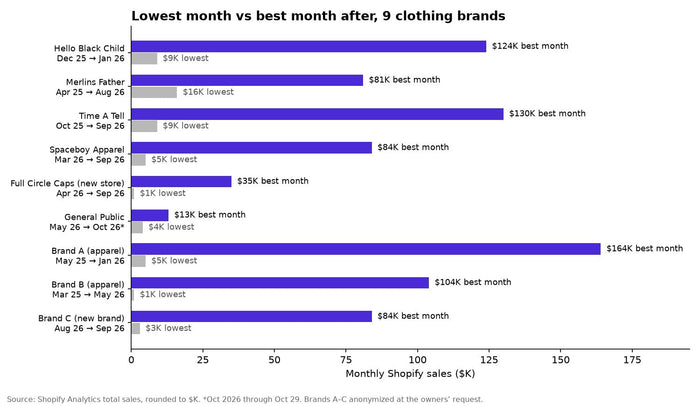
Client Results: 9 Clothing Brands, From Their Lowest Month to Their Best
Nine clothing brands, one honest comparison: each brand’s lowest month against its best month after, straight from Shopify.
Read it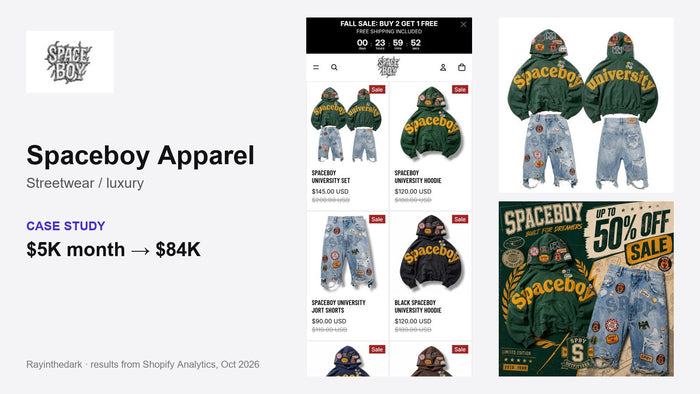
Case Study: Spaceboy Apparel, From a $5K Month to $84K
A streetwear and luxury brand that went from a $5K March 2026 to $84K in September and $83K in October,...
Read it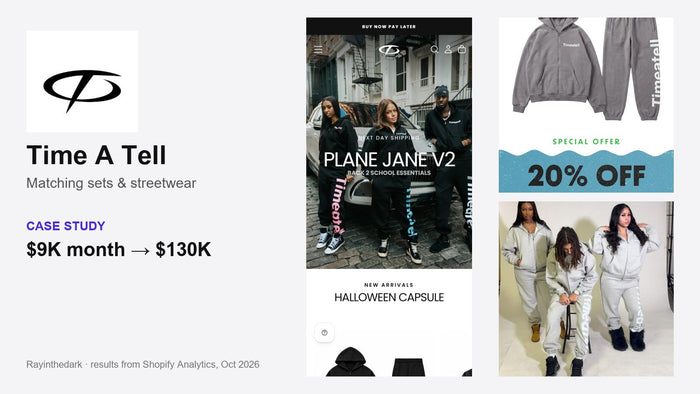
Case Study: Time A Tell, From a $9K Month to $130K
A streetwear brand known for matching sets. From a $9K October 2025 to $105K, $130K and $101K months in August...
Read it