
Case Study: Time A Tell, From a $9K Month to $130K
A streetwear brand known for matching sets. From a $9K October 2025 to $105K, $130K and $101K months in August to October 2026, with conversion nearly tripled.
By Ray · Updated

Time A Tell is a streetwear brand built around matching sets, above all the Plane Jane set, with next-day shipping. In October 2025 it had its weakest month of 2025–26. Eleven months later it was doing more than $100K a month.
The results
| Lowest month (2025–26) | October 2025: about $9K |
| Best month after | September 2026: $130K |
| August to October 2026 | $105K · $130K · $101K (October through the 29th) |
| Conversion rate | Under 1% through 2025 (0.49–0.94%) → 1.58% in October 2026 |
| Traffic | 50,459 sessions in 30 days, 97% on phones |
| Meta ads | Original account $55.3K → $192.4K (3.5x); new account since October 11: $3.8K → $22.4K (5.9x) |

The website: before and after

| October 2025 | Now | |
|---|---|---|
| Header | The store’s handle typed as text ("shoptimeatell") | The real logo |
| Top bar | Scrolling text about a collab | "Buy now pay later": an answer to the price question |
| Hero | "New arrivals / Shop now" over a dark, cropped photo | Three people in the set on a real street, the product name ("Plane Jane V2") and "Next day shipping" |
| Products | A long grid of many styles with long all-caps names | A focused new-arrivals capsule, sets first |
The lesson: the first screen has to say what you sell, who it’s for and why to buy now. "New arrivals" says none of that. "Plane Jane V2, next day shipping" with people wearing it says all three. Conversion went from under 1% to 1.58% while traffic grew, which is the harder direction.
The ads that sold

| Ad | Format | Spent | Revenue (Meta) | Return | CTR | Cost per click |
|---|---|---|---|---|---|---|
| "48 hours only: 20% off" (code TELL20) | Image | $953 | $7,927 | 8.32x | 1.33% | $0.78 |
| Plane Jane set, buy now pay later (reel) | Video | $1,599 | $7,275 | 4.55x | 1.82% | $0.80 |
| "24 hours only: up to 40% off + free shipping" | Image | $659 | $5,762 | 8.74x | 1.44% | $0.43 |
| "Plain Jane sets, pre-made, free shipping" | Image | $699 | $4,660 | 6.67x | 1.09% | $0.60 |
Why these worked:
- The offer is the headline. Three of the four winners lead with the deal and a deadline. For an impulse-buy audience, the offer is what earns the click.
- Price objection handled in the ad. "$130 without paying it all today" with buy now, pay later turns a $130 set into an easy yes.
- Clean product shots. Most winners are the set on a white background. The product is the hero.
- Shipping in the copy. "Pre-made", "next-day shipping", "free shipping" answer the second-biggest question after price.
When Meta disabled the original ad account in October, a new account went up the same month and returned 5.9x in its first 18 days. Keep your creative and audiences documented so an account problem doesn’t become a sales problem.
Email and SMS: one message per group

Instead of blasting the whole list, each of the November texts is scheduled for one group: repeat buyers get "regulars first" access, one-time buyers get the next colour of what they bought, people who clicked but didn’t buy get shipping and returns reassurance, lapsed buyers get new arrivals, and new subscribers get a sizing guide.
The playbook you can copy
- Rewrite your first screen: product name, people wearing it, shipping promise.
- Answer price in the top bar and in the ads (buy now, pay later; free shipping).
- Lead ads with a real offer and a real deadline.
- Fix conversion first, then scale spend.
- Segment your texts.
Mistakes to avoid
- A homepage that says "New arrivals" and nothing else.
- Showing twenty styles when two sets are your best sellers.
- Limited-code or "no restock" claims you can’t keep. Urgency only works while customers believe it.
How we report results: sales figures are Shopify total sales from each store’s own analytics, read on October 29, 2026. Ad figures are Meta’s attributed purchase value. We compare a brand’s lowest month with the best month after it; drop brands have quiet months between drops by design, and we say so where it applies. October 2026 runs through the 29th.
Want our team to do this for your brand?
We run Meta ads, Shopify websites, email and SMS for 304+ brands, more than 200 of them clothing brands. On a free strategy call we look at your store, ads and emails and show you what we would fix first.
More: traffic but no sales? · how to read Meta ads · all client results
KEEP READING
More from the blog.
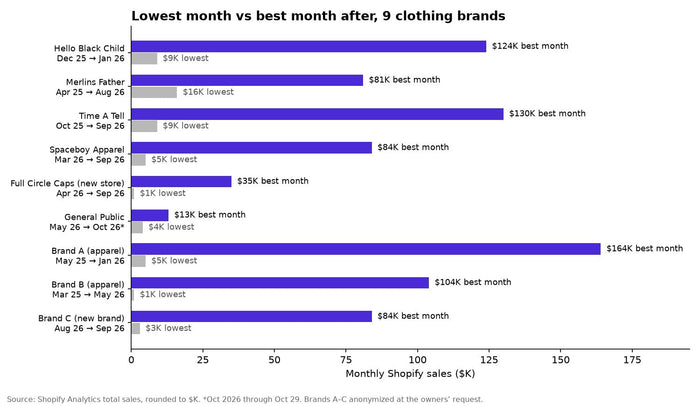
Client Results: 9 Clothing Brands, From Their Lowest Month to Their Best
Nine clothing brands, one honest comparison: each brand’s lowest month against its best month after, straight from Shopify.
Read it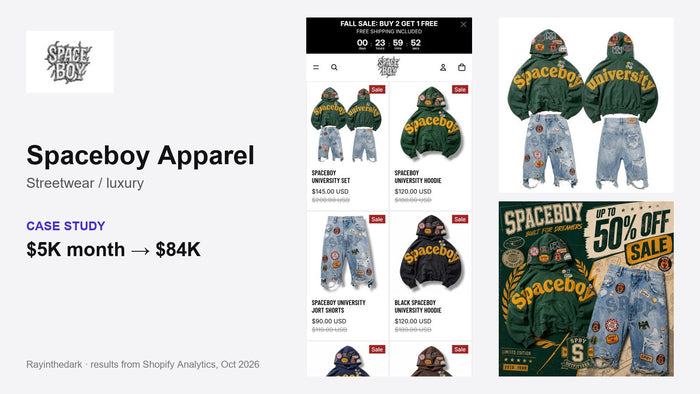
Case Study: Spaceboy Apparel, From a $5K Month to $84K
A streetwear and luxury brand that went from a $5K March 2026 to $84K in September and $83K in October,...
Read it
Case Study: Merlins Father, From a $16K Month to $825K a Year
A streetwear brand that grew from a $16K month in April 2025 to $81K months and $825K over the last...
Read it