
How to Read Meta Ads: CPM, CPC, CTR, Frequency and ROAS Explained for Clothing Brands
Ads Manager tells you exactly what is wrong if you know how to read it. The five numbers we check on every clothing brand account, with real examples.
By Ray · Updated
Most brand owners who say "ads don't work for me" have never read their own numbers. Ads Manager tells you whether the problem is the creative, the offer, the audience or the website. You only need to know which number points where.
These are the five numbers we check first on every clothing brand account, the ranges we work with, and what to do when one is off.
Set up a view you can actually read
Ads Manager's default columns hide most of what matters. Click Columns → Customize columns and build a view with: amount spent, CPM, CTR (link click-through rate), CPC (cost per link click), frequency, purchases, purchase conversion value and purchase ROAS. Save it as a preset so it is there on every account. Then look at it at the ad level, not only the campaign level, because each ad tells its own story.
1. CPM: is your content getting seen cheaply?
CPM is what Meta charges to show your ad 1,000 times. Meta charges less for ads people stop and watch, so CPM is mostly a verdict on your creative.
- Under about $15: excellent for clothing.
- $15 to $20: workable, but the creative can do better.
- Over about $20: people are scrolling past. Make new content before you raise the budget.
2. CTR: do people care enough to click?
Link click-through rate is the share of people who saw the ad and clicked through to your site. Around 1% means the ad gets seen but doesn't make anyone curious. Our better clothing ads usually sit between 2% and 4%.
3. CPC: what does one visitor cost?
- 50¢ or less: excellent.
- 50¢ to $1: fine.
- Over $1: you are paying a lot for every visitor, and they still have to get through your whole website to buy.
A cheap CPM with an expensive CPC is a specific signal: the content gets seen, but nothing gives people a reason to click. That is usually the offer. Add one (a bundle, buy-one-get-one, free shipping, a real deadline) or make it clearer in the first seconds.
4. Frequency: has everyone already seen it?
Frequency is how many times the average person has seen the ad. On a 7-day view, once it passes about 2, you are mostly re-showing the same people and results usually start to slide. That is your cue for fresh creative, not a bigger budget. Over long date ranges frequency always reads higher, so check it on recent days.
5. ROAS: what came back for every dollar?
Purchase ROAS is revenue divided by spend. It is the number we judge ads on, together with total spend and total revenue. Cost per purchase is useful context, but a $13 cost per purchase on a 6x ROAS ad is still a great ad. What ROAS you need depends on your margins: a brand with 70% margins can live on a lower ROAS than one with 40%.
Read them together: a real example
Here is Full Circle Caps at ad level over the last 90 days. Across these ads the account spent $15,125.95 and brought back $44,465.69 (2.94x).

- BID CAP 5 is the textbook winner: $13.79 CPM, 3.97% CTR, 35¢ per click, 5.93x return. Cheap to show, people click, and they buy.
- BID CAP 1 is the opposite: $22.70 CPM and $1.11 per click. It still sold, but at 2.80x it was the weakest of the group. That is a creative to replace, not to scale.
- V3 shows why you never judge on one number. Its CPM was high at $22.64, yet it returned 4.96x because the people who did click bought. Cut it on CPM alone and you lose a winner.
When to judge a new ad
Don't decide after $10. A simple rule we use: let an ad spend at least your average order value (if your hoodie orders average $60, let it spend $60) before judging, and ideally $50–$100. By then CPM and CPC are reliable, and purchases start to show whether the ad sells.
What each problem points to
| What you see | Usually means | Fix |
|---|---|---|
| High CPM | Content isn't stopping the scroll | New creative: real people wearing it, quick cuts, a hook in the first 3 seconds |
| OK CPM, low CTR, high CPC | Nothing makes people click | Lead with an offer or a reason to look now |
| Good CTR and CPC, no purchases | The website is losing them | Product pages, sizing, trust, checkout (our store fix guide) |
| Rising frequency, falling ROAS | The audience has seen it all | Fresh concepts every week |
Learning to read these takes some spend. Every winning account we run started with tests that lost money. The difference is reading what each test told you and acting on it.
Want our team to do this for your brand?
We run Meta ads, Shopify websites, email and SMS for 304+ brands, more than 200 of them clothing brands. On a free strategy call we look at your store, ads and emails and show you what we would fix first.
More: Why most clothing brands fail with Meta ads · How to make winning ad creatives · Our Meta ads service
KEEP READING
More from the blog.
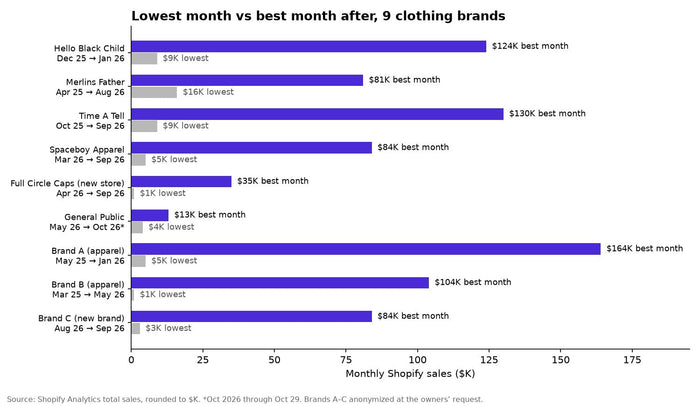
Client Results: 9 Clothing Brands, From Their Lowest Month to Their Best
Nine clothing brands, one honest comparison: each brand’s lowest month against its best month after, straight from Shopify.
Read it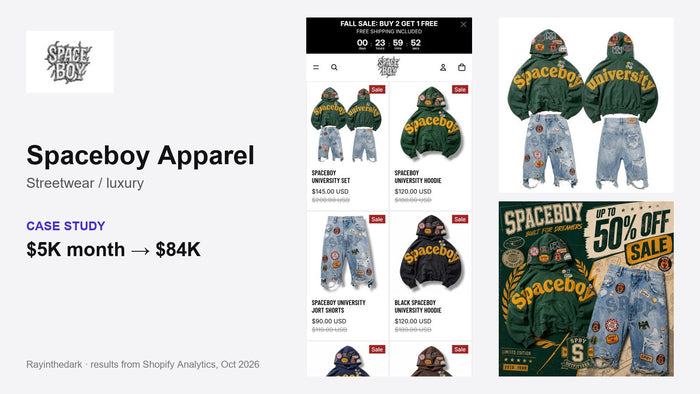
Case Study: Spaceboy Apparel, From a $5K Month to $84K
A streetwear and luxury brand that went from a $5K March 2026 to $84K in September and $83K in October,...
Read it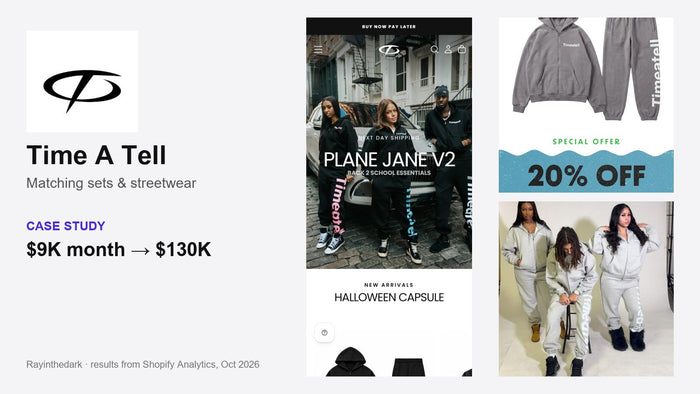
Case Study: Time A Tell, From a $9K Month to $130K
A streetwear brand known for matching sets. From a $9K October 2025 to $105K, $130K and $101K months in August...
Read it