
Why Most Clothing Brands Fail With Meta Ads (and How to Fix It)
Most clothing brands blame the ad account. Usually it is the order they built things in, the numbers they read and the content they feed Meta. Here is what we fix first.
By Ray · Updated
Most clothing brand owners who tell us "Meta ads don't work" have the same story. They boosted a few posts, spent $200 to $300, got some clicks and no sales, and decided ads are a scam. Ads aren't a scam, but they're not a cash machine either. An ad gets the right person to look at your brand. Everything after that click, from your website to your offer to your follow-up, decides whether they buy.
This guide is what we teach brand owners on calls, taken from the ad accounts we run for clothing brands. It covers the order to build things in, the five numbers to read, how to structure testing and retargeting, and the brand-side habits that make ads work.
1. Ads are the last thing you build, not the first
The most common mistake is running ads to a store that isn't ready. Ads are a bridge from Instagram to your website. If the website doesn't convert, the bridge just delivers people to a dead end faster. The order we build in:
- Website. Clear product photos, sizing, reviews, shipping info, a fast mobile experience. (Our guide: Getting traffic but no sales?)
- SMS and email. A popup that captures visitors, plus the automations that bring back people who didn't buy the first time.
- Ads. Only now does every click have somewhere to go and a way to be followed up.
Also expect a ramp. Your first few hundred dollars buy data, not profit. Meta needs purchases to learn who your buyer is. Budget for a testing phase instead of judging the channel on week one.
2. The five numbers to read in Ads Manager
Build a custom column view (Columns → Customize columns) so these sit side by side for every campaign, ad set and ad. These are the ranges we use for clothing brands; every account is different, so treat them as warning lights, not laws.
| Metric | What it tells you | Our rule of thumb for clothing |
|---|---|---|
| CPM (cost per 1,000 impressions) | How much Meta charges to show your ad. High CPM usually means the creative isn't holding attention. | When it climbs past about $20, the creative is usually the problem. Replace it rather than raising the budget. |
| CPC (cost per link click) | What it costs to get one person to your site. High CPC points at a weak hook, offer or call to action. | Aim for roughly 50¢ to $1. Past $1, you are paying a lot for each visitor. |
| Frequency | How many times the average person has seen the ad. | Above about 2, you are mostly re-showing the same people. Time for fresh creative. |
| ROAS (purchase return on ad spend) | Revenue Meta attributes for every dollar spent. | This is the number we judge ads on, alongside total spend and total revenue. |
| Cost per purchase | Spend divided by purchases. | Useful, but don't over-read it. A $13 cost per purchase on a 6x ROAS ad is a winner. |

Read them together. A cheap CPM with an expensive CPC means people see the ad but don't care enough to click. A cheap CPC with no purchases sends you back to the website. A rising frequency with a falling ROAS means your audience has seen everything you have.
3. Your organic content is fuel for your ad account
When an ad account struggles, the first thing we check is the brand's Instagram. Too often the last post was months ago. A brand that looks dead on its own page doesn't convert cold traffic, because people click the ad, check your profile, and leave.
The brands we scale fastest post constantly: quick-cut videos, trending sounds, the product on real people, every day. Organic content does three jobs for your ads:
- It proves the brand is real when a cold customer checks your profile.
- It tests ideas for free. Posts that take off organically are your next ads.
- It builds the warm audience your retargeting campaigns need.
Use Instagram's trial reels to test content on non-followers without cluttering your grid. Let engagement happen naturally. Content that sparks real comments beats begging people to "comment below".

4. Shoot for the website and shoot for the ads, separately
Website photos and ad creative do different jobs. Website photos answer "what exactly am I buying?": the garment on a model, front, side and back, close-ups of the print and fabric, consistent lighting. Ad creative stops a scroll: video, flyers, the product in a real place, an offer. When one shoot tries to do both, you usually get a store that doesn't show the product properly and ads that look like catalogue shots.
Our most-reused winning ad style is simple: the garment hung somewhere unexpected and real, shot on a phone. One of those spent $127 and brought back $1,100, and the same idea has worked across several accounts. Simple, real and different from what's in the feed usually beats polished.
5. A testing structure that works for most clothing brands
- Use ad set budgets (ABO) to test. Each ad set gets its own budget, so you can see clearly which audience and which ads win. Once you have winners, a campaign budget (CBO) can move money to them automatically.
- Start broad. 18 to 65, all genders, no interests. Meta's targeting now leans on your creative to find the buyer, and broad often beats narrow for brands doing up to six figures.
- Test one variable per ad set. In one account, the two winners were broad 18–65 on highest volume and 18–44 men on highest value (which looks for buyers likely to spend more). Each ad account has its own personality. Test, don't copy.
- Test concepts, not tiny variations. Ten versions of the same video with different captions is one test, not ten. Change the idea: a try-on, a founder clip, a flyer with the offer, a customer wearing it, the product in a real setting. Ads in fashion tire out within weeks, so keep new concepts coming every week.
- Match the copy to the brand. Offer-led copy ("48 hours, $55, ships next day") works for hype and impulse audiences. Luxury brands often do better with no offer at all. Whichever you use, the urgency has to be true. Fake "never restocking" lines cost you trust the day you restock.
6. Retargeting: set it up once, let it run in the background
Retargeting shows ads to people who already showed buying intent. It's usually your most profitable campaign, but it needs data, so build it once your store has steady traffic.
- In Ads Manager, open the menu → Audiences → Create audience → Custom audience → source: Website.
- Include people who Added to cart, Initiated checkout and Added payment info in the last 90 days.
- Exclude people who Purchased in the last 120 days. Name it something like "90-day RT".
- Create a Sales campaign, then in the ad set include that custom audience.
- Start around $20 a day. Use offer creative here, like a bundle, free shipping or a deadline, because these people already know the product.
On one client account, a two-ad retargeting campaign spent $220 and returned $1,054 (4.8x), running quietly beside the main campaigns.
7. The brand-side habits that make ads work
The best results we've had came from brand owners who did their part, not from secret settings:
- Ship fast. Pre-made stock that ships in a few days creates repeat buyers. Long pre-order waits kill repeat purchases and make every sale cost more. Pre-order is fine to build capital; move to pre-made as soon as you can.
- Answer customers and send tracking. Happy customers come back without ad spend, which lifts your blended return.
- Build offers together. Bundles and sets raise order value, which gives the ads more room to be profitable. (See: the High-AOV Playbook.)
- Feed the account. New photos, new videos, new drops. Ads run on content.
Checklist before you spend another dollar
- Would you buy from your own store on your phone?
- Is an SMS/email popup capturing visitors who don't buy?
- Have you posted on Instagram this week?
- Do you have at least 3 genuinely different creative concepts ready?
- Is your column view set to CPM, CPC, frequency, ROAS and cost per purchase?
- Is a 90-day retargeting campaign running?
- Is all your urgency and scarcity true?
Want our team to do this for your brand?
We run Meta ads, Shopify websites, email and SMS for 304+ brands, more than 200 of them clothing brands. On a free strategy call we look at your store, ads and emails and show you what we would fix first.
More from Ray: our Meta ads service · the free Meta ads course on YouTube · Meta Ads Variable Test SOP Pack
KEEP READING
More from the blog.
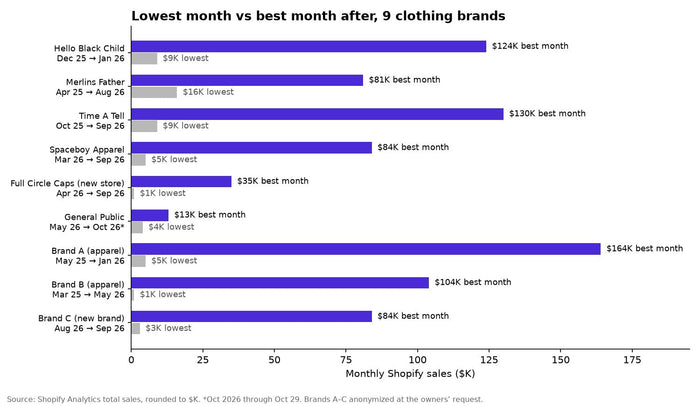
Client Results: 9 Clothing Brands, From Their Lowest Month to Their Best
Nine clothing brands, one honest comparison: each brand’s lowest month against its best month after, straight from Shopify.
Read it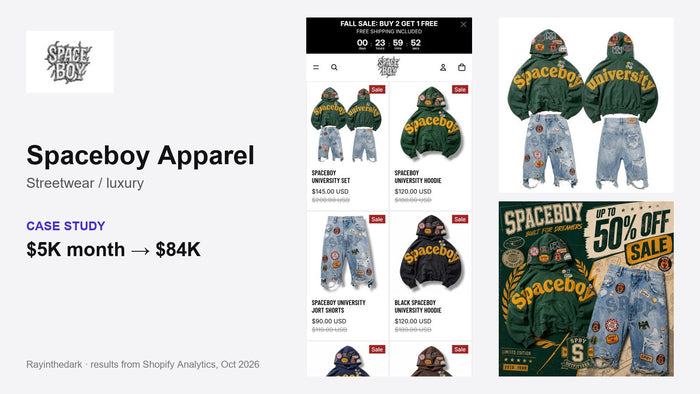
Case Study: Spaceboy Apparel, From a $5K Month to $84K
A streetwear and luxury brand that went from a $5K March 2026 to $84K in September and $83K in October,...
Read it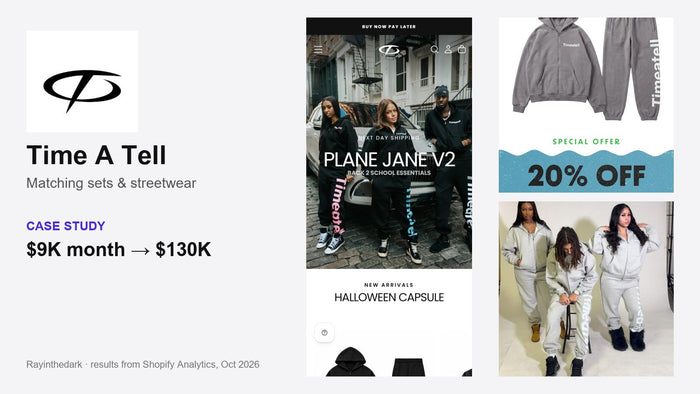
Case Study: Time A Tell, From a $9K Month to $130K
A streetwear brand known for matching sets. From a $9K October 2025 to $105K, $130K and $101K months in August...
Read it